Sunday, April 3, 2016

Tips for Dealing with POTS Symptoms from my own Experience:

Heat Intolerance:
  • Carry a small portable fan around where ever you go, especially in the summer time. 
    • Suggestions: O2 Cool Fan (Amazon or Bed Bath and Beyond)
  • Carry cooling towels 
    • Suggestions: BodyFit (Sports Authority) Frogg Toggs Chilly Pad Cooling Towel (Amazon)
  • Carry a small spray bottle filled with water to help cool down quickly (very helpful for after workout, especially if you cannot sweat like me!) 
  • Wear lays so if your in class/work and you get hot you can take your sweatshirt/jacket off
Dizziness/Lightheadedness:
  • Eat a lot of salt and take salt tablets 
    • Suggestion: Thermotabs (Amazon) 
  • Drink sports drinks like Gatorade or Powerade
  • Add Nuun Active Hydration tablets to water (has electrolytes with out the high sugar and calories) 
    • Can buy them on Amazon or Nuun.com 
  • Do boluses of fluid before activities that will cause dizziness/lightheadedness like getting out of bed in the morning, working out, showering, etc...
  • Change positions slowly 
Racing Heart:
  • Meditation and deep breathing exercises 
    • Suggestion: Stop, Breathe, Think App, Pacifica App, Breath2Relax App
  • If anyone else has tips on how to slow my heart rate down please feel free to comment! 
Insomnia:
  • Meditation and deep breathing
  • Only using your bed for sleeping-no watching Netflix, no doing homework. etc... in bed
  • Don't take naps :( 
  • Don't use cell phone/other electronics before bed or in bed 
Stomach Pains/Lost Appetite:
  • Eat small frequent meals throughout the day (snack every 2 hours or so)
  • Wear an abdominal  binder to prevent blood pooling to the abdomen 
  • Experiment with different foods
    • For example I eliminated gluten and feel a lot better 
  • Even if your not hungry try to eat a small snack like nuts (which are high in protein) 
Blood Pooling in Legs/Feet:
  • Compression stockings
    • For me the thigh high stockings worked better then the knee highs  
  • Leg exercises to build up muscle strength 
  • Squeezing legs together to help bring the blood back up 
  • Do not stand in the same spot for a long time, always move around 
  • If really bad, lay on your back with your feet in the air (helps when feeling like your going to pass out also!)
Taking a Successful Shower:
  • Get a shower stool/chair
  • Take a lukewarm shower (NOT hot)
  • Don't stand in one place, keep your feet moving to prevent blood pooling 

Tuesday, March 22, 2016

Mayo Clinic Day 6 (Last Day)

Today was my last day at Mayo Clinic. I got my results from all my tests and I definitely have POTS and chronic fatigue. From all the blood tests, it was found that my iron is low so I have to start taking iron pills to see if they help the cramping in my legs. From the overnight oximetry test my oxygen levels were normal, but my heart rate was extremely high. When I am sleeping my heart rate gets around 115bpm, which ends up causing restless sleep. I am hyperactive at night and am in “fight or flight” mode, which is causing my heart rate to get high and causing my insomnia. I end up not getting proper sleep, and I do not reach Stage 4/REM sleep, so during the day I get foggy and I go into stage 1 of the sleep cycle without even knowing it (that explains why I don’t remember conversations, chunks of class time, etc…). To lower my heart rate, Dr. Fleming changed my beta-blocker and if the beta-blocker doesn’t help me get sufficient sleep, I have to start taking a sleeping pill. My tilt table test was also abnormal since my heart rate spiked at a 70O angle. This confirmed my POTS since it showed signs of orthostatic intolerance. Since my heart rate gets high, the echo and EKG were necessary to check for any damage or abnormalities in my heart and both tests were normal (finally a normal test!!).
The thermoregulatory sweat test came back abnormal. The doctor was shocked that it did because he has only seen abnormal results four other times in the past. Parts of my arms, thighs, and feet do not sweat, which points to about 26.2% nerve damage. I have to be extremely careful in the heat because I am incapable of cooling myself down since I do not sweat. I may need to get a nerve biopsy to further investigate this issue. Also, in a year I need to do another sweat test to see if the nerves are rejuvenating themselves, are the same, or if there is further damage. Before I left the clinic, I had to do a paraneoplastic antibody blood test to check to see if the reason for the nerve damage is autoimmune. If this test comes back abnormal, I could possibly have a disorder such as ganglionopathy, but further testing needs to be done. He suggested carrying a fan around, which I already do, and using a spritz bottle when I work out to help cool down. I also have to find a neurologist that specializes in the autonomic nervous system to take care of this problem.
He said that the POTS has caused central sensitization syndrome. My central nervous system (mostly in the area of my brain that controls autonomic functions called the limbic system) does not process sensation properly and overreacts to different sensations. When something is painful, it is significantly more painful because of this sensitization. When I was having terrible stomach pain whenever I ate in the fall, my stomach nerves were sending signals to my brain that the food was painful. My central nervous system has regulated itself into a hyperactive state so everything is more extreme for my body. Another system that is being affected is my vestibular system in my inner ear. My vestibular system coincides with the autonomic dysfunction and the central sensitization syndrome and causes my dizziness.
            Adapting to POTS is the only way to get a handle on your life. Some remedies, besides prescriptions, Dr. Fleming suggested was to wear support stockings, compression shirt/shorts, and/or an abdominal binder. These garments can help with blood pooling in my legs and stomach, the only problem for me is I have to be careful that they do not cause me to overheat. Salt and fluids are also two therapies that are necessary. I was only taking in 2-3 grams of salt a day, but Dr. Fleming recommended taking 10-20g of salt a day especially since my sodium levels were on the lower side (I guess I wasn’t adding enough salt to my pizza every night). Some suggestions for increasing salt intake were thermotabs, sodium chloride pills, and adding table salt to food, sports drinks and pedialyte. Also, I need to drink about 2-3 liters a day. He suggested using Nunn Active Hydration Electrolyte Enhanced Drink Tablets, which is added to water and is high in salt and electrolytes. Another recommendation to help with increasing fluids and also helping with standing for longer periods of time are water boluses. Water boluses are when you drink 12-16oz of water quickly at one time before an upright activity because it helps increase blood pressure and lower heart rate. To get the most out of water boluses, you need to do it 3-4 times a day, and they tend to be more helpful than sipping water. Some positions that can help with blood pooling and lightheadedness is crossing legs, bending forward, and engaging leg muscles. By engaging leg muscles, the blood pooling in your feet/legs gets pushed back to your heart and redistributed throughout your body.
            The best way to subside symptoms is exercise. It was suggested to do at least 30 minutes of cardio a day, and cardio can be the recumbent bike and swimming. It is also suggested to do weight lift training 2-3 times a week. Leg exercises are the best form of weight training for POTS patients because it helps prevent blood pooling. Some exercises recommended were yoga, leg presses, toe presses, leg extensions, and leg curls. As an exercise routine gets easier, it is necessary to continue to increase weight and resistance, and keep pushing yourself. Some other recommendations I was given to control my heart rate was deep breathing exercises. Deep breathing helps to lower heart rate and makes your body relaxed. When your body is relaxed it helps to get out of the “fight or flight” response and taps into the parasympathetic nervous system. Some videos that Dr. Amit Sood has uploaded to YouTube were also suggested (Calm and Energize: A Meditation With Your Breath). Meditation is a great therapy for POTS patients because it helps to calm down the sympathetic nervous system and help to get control over symptoms.

            The past ten days have been long and exhausting, but definitely worth it. I have learned a lot more about the causes of Postural Orthostatic Tachycardia Syndrome and different ways to control it. Through this experience I have learned a lot about my body and why it is reacting abnormally. It will be years till I am better, but with time, patience, and these different therapies I will be able to control my symptoms and be better. Some symptoms may never go away, but with autonomic dysfunction you just have to learn to adapt, and live life to its fullest with the symptoms that are present. (If you ever go to Minnesota or the Mayo Clinic, definitely check out the Eagle Sanctuary and Mall of America…GREAT SHOPPING!! J)

Friday, March 18, 2016

Mayo Clinic Day 4 and 5

Yesterday and today were short days so I decided to combine posts. I have an appointment for acupuncture on March 31st and since I do not want to stay in Minnesota for an extra week I plan on skipping it. Yesterday, I went to go see if there were any cancellations for the acupuncture appointment and waited to see if the patients came, and they did so I couldn’t get in early. I have tried acupuncture in the past and I did not feel like it had any effect on me besides making me tired after the treatment. Since I am already so fatigued, the acupuncture just made me more tired and I didn’t like the experience.
The only real appointment I had yesterday was a catecholamine test. For this test you couldn’t eat or exercise four hours before. I went into a room and had an IV put in, and I had to lie down for 30 minutes. The nurse told me to stay as relaxed as I can, and she shut the lights off and the room was quiet. I just watched the clock for 30 minutes, which was very boring. After 30 minutes, the nurse came in and drew blood. She then told me to go walk around for 10 minutes and come back. After the 10 minutes of walking up and down the hallway, she took more blood. This test is to see if there is a difference in dopamine, norepinephrine, and epinephrine (adrenaline) levels when lying down and relaxed and to see if there is a difference in levels when I am walking around. For a POTS patient, walking around is very stressful on the body so they want to check how high my hormones get upon standing and walking.
Today, I had a biofeedback consultation where I learned the basics of slow breathing and relaxation. The woman put a monitor on each of my shoulders and a strap around my stomach, and these three devices monitored the tension in each shoulder and my breathing. They transmitted information about my breaths per minutes and amount of tension in my shoulder onto the computer screen. During this session I practiced slow, even breathing, which helps control POTS symptoms. By breathing slowly and evenly, it slows down my heart rate, which prevents chest pain and also this type of breathing helps with stress. Since stress is a major POTS trigger, it can make symptoms significantly worse. Since my sympathetic nervous system is dominant over my parasympathetic nervous system, I am constantly in “fight or flight” mode so even a little bit of stress can have a negative impact on my body. She also said this breathing technique can help with my migraines and insomnia.
She said to practice these breathing exercises throughout the day, especially when I am preoccupied with something else because then this type of breathing will become more natural. Some apps she suggested to use to help with these breathing techniques were “BellyBio Interactive Breathing”, “Breathe2Relax”, and “My Calm Beat”. I have to practice biofeedback twice a day for 20 minutes for a few weeks to really start seeing an effect.

The biofeedback consultation was my last appointment before I get my results on the tests and see Dr. Fleming again. On Tuesday, I will see the doctor and he will let me know about all the tests I went through this week and possibly suggest new techniques or medicines to help subside symptoms. As a nice way to end this long week of testing, my mom and I are going to see Zootopia. So pumped to see Flash the sloth J

via GIPHY

Wednesday, March 16, 2016

Mayo Clinic Day 3

           Today was a hot one! The morning was easy, just information sessions of what POTS is and relaxation techniques. The woman was surprised with how much I knew about POTS and the autonomic nervous system, being pre-med does that. Whenever I have an autonomic nervous system question on a test I get pumped! The woman realized I pretty much knew all the basics about POTS, so we mostly spoke about stress management and relaxation techniques. An interesting thing she did say was how the blood flow can cause stomach pain. Since my blood is not flowing properly in my body, when I do not eat frequent small meals, blood is not constantly assisting in digestion. When I eat a large meal and not frequently a lot of blood goes rushing to my stomach, which causes pain. So the ideal way to eat for POTS patients is small meals or snacks every few hours. She gave me a lot of handouts about foods high in salt, what POTS is, and exercises that are good for POTS patients. Relaxation and training your frontal lobe is also important for POTS patients since we are constantly in “fight or flight” mode, and our body is constantly in a stressed out state. By teaching the frontal lobe to relax the brain is retrained to not always be in a stressed out state, which can help with symptoms, such as lowering heart rate.
            Some relaxation techniques that are helpful in retraining the frontal lobe is deep breathing (breathing from the belly) and muscle relaxation. The teacher also gave me videos on yoga and tai chi. She said there are five criteria that POTS patients need to follow to get control over their bodies. The five criteria are relaxation techniques, exercise, healthy diet, adequate sleep, and spiritual wellness, which is a sense of connection with other people and not isolating yourself from others. She also said to make a list of three things, a joy list, to incorporate into daily life. Some examples include doing yoga, going outside and take pictures, etc… After my information session I went back to my room and took a nap before I had to bring back my heart monitor and BP holster (yes, every 10minutes my BP was being taken and it was very annoying).

            After giving back the monitors, the next test for the day was my sweat test, which, so far, I think is the worst test I had to do. When you walk into the testing room you see a large rectangular box, a human oven, and computers. You are provided with a bathroom to get changed in and shower after the test. After getting changed I lied down on the table and a gold power was sprinkled all over me. The only place that powder wasn’t on was my back and face. The gold powder was made of baking powder, cornstarch, and alizarin red. The alizarin red reacts with sweat and changes the color of the powder from gold to purple. After putting my sunglasses on, the technician put me in the oven and the temperature went up to 104OF. I had skin thermometers on my stomach and legs, and a thermometer in my mouth. If my oral temperature reaches 100.4OF then the test would have been stopped. While lying in the human oven I noticed I wasn’t turning purple, even though it was really hot. I have issues with heat intolerance so the heat was making my heart race, and I was doing deep breathing to prevent myself from passing out. I kept trying to talk to the technician and ask him questions, and he would open the window and I would feel the cool air. He told me that the test was more then half way over, the total time was about 45 minutes, and I still wasn’t purple because I wasn’t sweating. By the last 15 minutes or so I finally started sweating, and by the end I was mostly purple but still had some spots of gold left. When the technician finally pulled me out of the human oven room temperature felt cold and it was amazing. It took me awhile to sit up and stand because my heart was racing and I was lightheaded. Since your entire body is covered in sweaty, purple powder, they let you shower, but after the shower I still had a slight purple hue and needed a few more showers. This test was not fun and really hard on my body. I was very foggy and exhausted after this test and after having a late lunch ended up watching the latest episode of New Girl and taking a nap.

Tuesday, March 15, 2016

Mayo Clinic Day 2

Day 2 was definitely not as long as Day 1! I woke up a few times last night and looked at my pulse-ox monitor and my heart rate got up to 107 just from sleeping. I guess when your heart rate is over 100bpm that will wake you up. My first test this morning, at 8am, was my echocardiogram. The technician did a sonogram of my heart to look for anatomical abnormalities, which took 45 minutes to do the actual test and 30 minutes for the doctor to evaluate the scans. The technician who did my echo had a lot of the same symptoms as me. When she walked in she said that when she read my records she thought she was reading her own, and said that lifestyle change is the best cure.
After my echo, I went for my autonomic test. I tried to get a picture on the tilt table, but the technician wouldn’t let me (apparently it’s copyright infringement to take pictures of the equipment…who knew). The moment I got in the room the technicians had me take my shoes off, pull my pants up over my knee, and attach a heart monitor. The first test they did was attaching electrodes to my left leg to test for my sweat response. Syringes were attached to the electrodes with acetylcholine. The acetylcholine was applied to my skin to see if those areas of my body will sweat. After the acetylcholine was applied the electrodes were turned on. The technician said it would feel like your leg fell asleep, if his leg feels like that when it falls asleep he should get that checked out. The electrodes were not pleasant and stung. The electrodes were on for 5 minutes, but the painful stinging continued after the electrodes were turned off. The next part of the test they had me breathe in and out slowly to see how my heart rate was affected. The next breathing exercise I had to do was blow air out as hard as I could and continue for 15 seconds. It is harder than you think, especially when you have POTS. After the breathing tests, I had to do the tilt table test. They tied me down to the table, and they took vitals with me lying down. Then they lifted the table and left me like that for 10 minutes, and every 2 minutes or so they took vitals. I was expecting them to constantly change the position of the table, but I guess if they did that I would have passed out.
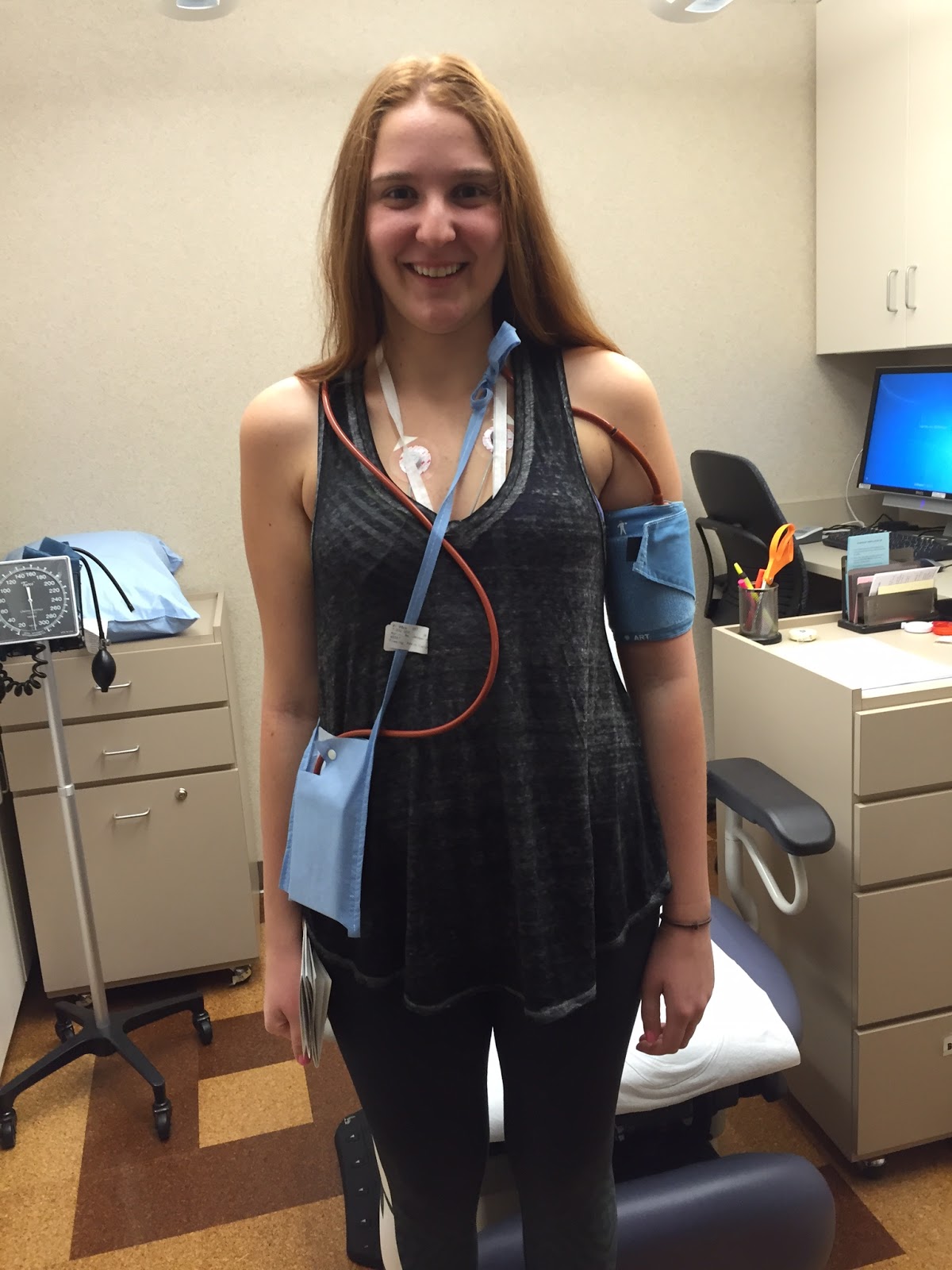
After the autonomic testing I had blood work to check my thyroid levels, to see if I have Hashimoto’s disease (just another disorder to add to my lengthy list). A few weeks ago, my antibody levels were high, so they wanted to recheck them, and see if the antibody levels have gone down. The next appointment my mom and I went to was to get my blood pressure monitor and heart monitor. I currently have a heart monitor on, and a blood pressure cuff around my arm that goes off every 10 minutes, which is very irritating. When the blood pressure cuff goes off I can’t talk or move, and I have to make sure my arm is relaxed. When my mom and I were walking to the elevator my cuff started to take my BP and I stopped in the middle of the hall, my mom did not realize I stopped and kept going. These monitors are on till 1pm tomorrow afternoon. At least tonight the timing changes to every 20 minutes. Sleeping will definitely be enjoyable tonight with a blue cuff constantly constricting my arm every 20 minutes.
I was supposed to have a hormone test today, but I didn’t read the directions so I ate an hour before, and you’re not supposed to eat for four hours prior to the test. I really need to start reading the directions. When we got back, I slept for two hours; between yesterday, not sleeping well last night, and today I needed a long nap. Tomorrow we have some classes to learn more about POTS and how to manage living with POTS and I will update you tomorrow night about all the new information I learn!


P.S my BP cuff is currently going off J

Monday, March 14, 2016

Mayo Clinic Day 1

Day 1 of my Mayo experience is finally over. I feel like this day would never end. My day started out with being woken up at 6:15 am, and by 7am, waiting in line for blood work. When I walked out of the elevator, I saw this long line of people waiting to register for their blood work, and felt like I was in the airport security line again. Surprisingly, the line went quickly; I was shocked how efficient and quick this hospital is. After waiting about fifteen minutes, a kind, cheery woman took me into the room to take eight vials of blood and administer my urine collection container (gross….). This preliminary blood test was just a basic blood panel checking to make sure my iron levels, electrolytes, body cells, etc… are all normal.
After the blood tests, I went on to my pulmonary and exercise test. After signing in, the pulmonary technician took me in the back to do preliminary breathing tests to see how my lungs are functioning. I sat in a clear box with a machine in it that connects to the technician’s computer. The machine had a mouthpiece attached to the end where I took a deep breathe, and blow as hard as I could into it. I repeated this test about four times. Next, I had to breathe in and out quickly into the mouthpiece. I had to repeat this process four times, which made me lightheaded. After the preliminary breathing tests, I went in to do my exercise test, which was exhausting. They first hooked me up to a heart monitor, which had wireless transmitters sending data to the technician’s computer. Next, they had me sit on a bike and attached a pulse-ox to my temple, a blood pressure cuff, and a mouthpiece; the mouthpiece made me look like Bane. The doctor came in and decided on what level I should start, and since I do exercise regularly the doctor decided to start on 60 watts and increase the resistance by 20watts. I made it to 140 watts, but by then I was extremely lightheaded and had some chest pain. I defiantly pushed myself, and my heart rate got up to 186 beats per minute. It took a while to start feeling better, but it made me feel tired for the rest of the day.
The consolation with Dr. Fleming was very informative. He let me speak and explain all my symptoms along with giving his initial thoughts. The consultation started with his nurse and then he came in; the whole appointment took about two and a half hours. An interesting thing he told me was that my brain fog could actually be me sleeping or dozing off. I guess if I want to take a nap in class I can now just blame it on POTS! Since I have insomnia and sometimes I don’t sleep the entire night, my body might be going into stage 1 or 2 sleep during the day causing me to get foggy and forget. He also believes that my past forms of dysautonomia (RSD and gastroparesis) are also connected to the POTS, and I am just predisposed to autonomic dysfunction.
After my long consultation I had an electrocardiogram to check my heart rhythm. I then went to go pick up my pulse-ox monitor for the test I am doing tonight. I have to sleep with a monitor on my finger to see if my heart rate increases while I sleep, which could contribute to the insomnia, and to monitor my oxygen levels. While I sleep, I may actually be high on adrenaline, which would cause my heart rate to spike and wake me up. My body just refuses to function properly. My last test, at 5:45pm, was a brain MRI with contrast. When I was first getting diagnosed with POTS, a small pituitary cyst was found so the doctor ordered an MRI to make sure the cyst has not grown in the past year. Personally, I think the MRI was the worst test. Whenever I go into an MRI I feel like I am in a coffin, so I made the technician put a towel over my eyes and I sang “Shots” by LMFAO in my head to get through it.
 It has been an extremely long day, but it will all be worth it in the end. I have already learned so much more about POTS and possible reasons why my body is not functioning properly. Not many people or doctors know a lot of information about the disorder, but the medical staff at Mayo definitely does!